

Torula longan Y.H. Yang & Manawasinghe
Classification – Torulaceae, Pleosporales, Dothideomycetes, Ascomycota
Index Fungorum number – IF900698; Facesoffungi number – FoF 14690
Other useful webpages – outlineoffungi.org; fungalgenera.org; Dothideomycetes.org
Etymology – referring to the host Dimocarpus longan, from where it was isolated.
Holotype – MHZU 22-0066
Description – Saprobic on dead branches of Dimocarpus longan. Sexual morph: undetermined. Asexual morph: Colonies effuse, dense, velvety, dark grey to black on the host. Mycelium 2–6 µm wide, immersed or superficial on the substrate, consists of smooth, branched, septate, light brown hyphae. Conidiophores 5–10 × 2–6 μm (av. 7 × 4 μm, n = 10), macronematous, mononematous, simple, flexuous, unbranched, smooth, thick-walled, subcylindrical, septate, brown. Conidiogenous cells 4– 8 × 4–6 μm (av. 6 × 5 μm, n = 10), monoblastic, intercalary or terminal, cupulate, pale brown to brown, smooth to minutely verruculose, thick-walled. Conidia 5–33 × 4–8 μm (av. 18 × 7 μm, n = 20), phragmosporous, catenate, in branched chains, acrogenous, moniliform, 1–5-septate, consisting of dark brown, subglobose cells, uneven in colour, sometimes apical cell smaller and paler than the other cells, straight or slightly curved, verruculose, thick-walled. Conidial secession schizolytic.
Culture characteristics – Colonies on PDA reaching 35 mm diam. at 28 °C after one month, raised, dry, rough, velvety, with dense hyphae in the middle and sparse hyphae at the edge, margin entire and nearly circular; from above, yellowish brown in the middle, pale brown at the margin; from below, dark brown to black in the middle, pale brown at the margin; not producing pigmentation in the culture.
Material examined – China, Guangdong Province, Guangzhou City, Baiyun Mountain (113°17′ E, 23°11′ N), on dead branches of Dimocarpus longan Lour. (Sapindaceae), 16 August 2021, Y.H. Yang, BLY013 (MHZU 22-0066, holotype); ex-type culture ZHKUCC 22-0121; ibid., living culture ZHKUCC 22-0122.
GenBank accession numbers – ZHKUCC 22-0121 = ITS: OR194035, LSU: OR194027, SSU: OR194032, tef1-α: OR228537, rpb2: OR228535; ZHKUCC 22-0122 = ITS: OR194036, LSU: OR194028, SSU: OR194033, tef1-α: OR228538, rpb2: OR228536.
Notes – See Dong et al. (2023).

Torula longan (MHZU 22-0066, holotype). a–c Colonies on dead branch. d–h Conidiogenous cells with conidia. i–k Solitary conidia. l, m Catenate conidia in branched chains. n, o Colony on PDA (front and below). Scale bars: d–h, l, m = 20 μm, i–k = 10 μm.
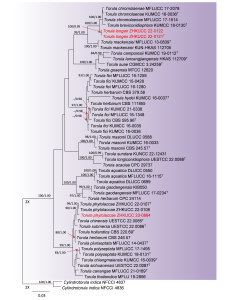
Maximum likelihood tree inferred from the combined LSU, SSU ITS, tef1-a and rpb2 sequence data for Torula longan. The tree is rooted to Cylindrotorula indica (NFCCI 4836 and NFCCI 4837). Maximum likelihood bootstrap support values equal to or greater than 80% and Bayesian posterior probabilities equal to or greater than 0.95 are shown near the nodes (ML/BYPP). Ex–type strains are indicated with “T ”. The new isolates from South China region are indicated in red, except for Torula phytolaccae.