

Thyridaria broussonetiae (Sacc.) Traverso
Classification – Thyridariaceae, Pleosporales, Dothideomycetes, Ascomycota
Index Fungorum number – IF569945; Facesoffungi number – FoF 08376
Other useful webpages – outlineoffungi.org; fungalgenera.org; Dothideomycetes.org
Description – Saprobic on the bark of Citrus maxima. Sexual morph: Stromata 0.5–1.0 mm diam., flaky, solitary or aggregated, yellow or pale brown, lose or dense fluff on the surface, fat circular to convex disc or poolville. Ascomata 300–660 µm high, 420–550 µm diam. (av. 480 × 500 µm, n = 10), immersed, solitary, part aggregated, subglobose, dark brown to black, central ostiole, with minute papilla. Ostiole 20–100 µm filled with black keratinous substance. Peridium 20 × 50 µm wide, consists of 5–7-layers of hyaline to brown, cells of textura angularis from the inside to the outside. Hamathecium of 2–3 µm wide, cylindrical, filamentous, unbranched, hyaline pseudoparaphyses. Asci 100–150 × 10–20 µm (av. 130 × 15 µm, n = 23), 4–8-spored, cylindric to clavate, slightly curved, with bulbous short pedicels, apically rounded, endotunica thick, wall thin. Ascospores 20–30 × 7–11 µm (av. 20 × 7 µm, n = 30), uniseriate, ellipsoid to fusiform, ends blunt, straight or slightly curved, pale or light brown when young, blackish brown at maturity, 3-septate, constricted at the septate, some have obvious guttulate, smooth-walled. Asexual morph: undetermined.
Culture characteristics – Ascospore germinating on PDA within 24 h at room temperature. Colonies on PDA reaching 35 mm diam. after 1 month at 25 °C, circular, white grey at the edge, dull brown to olivaceous brown from the center to edge, mycelium dense and soft. Reverse with dark brown center, light grey edge.
Material examined – China, Guangdong Province, Shaoguan City, Renhua County, Dongtang Town, 25°3′50″ N, 113°39′17″ E, alt. 100 m, on the bark of Citrus maxima (Rutaceae), 25 August 2021, Y.H. Yang (MHZU 22-0064, new host record); living culture ZHKUCC 22-0116, ZHKUCC 22-0117.
GenBank accession numbers – ITS: OQ976012, OQ976013; LSU: OQ976019, OQ976020.
Notes – See Senanayake et al. (2023).
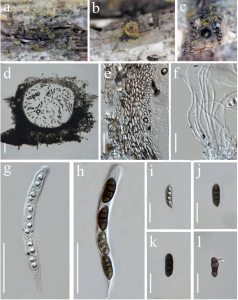
Thyridaria broussonetiae (MHZU 22-0064, new host record). a, b Ostiolar discs and stroma surface on the host substrate. c, d Vertical cross section of ascoma. e Peridium. f Pseudoparaphyses. g, h Asci. i–k Ascospores. l Germinating ascospore. Scale bars: d = 200 µm, e, f, i–l = 20 µm, g, h = 50 µm.
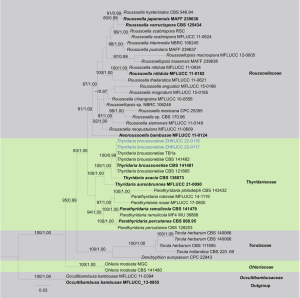
Phylogram generated from maximum likelihood analysis based on combined ITS, LSU and tef1-α sequence data for Thyridaria broussonetiae. Bootstrap support values for maximum likelihood equal to or greater than 70% and Bayesian posterior probabilities from Bayesian inference analysis equal to or greater than 0.95 are given at each node (ML/BYPP). The tree is rooted to Occultibambusa bambusae (MFLUCC 11-0394 and MFLUCC 13-0855). Ex-type strains are in bold. The new isolates from South China region are indicated in blue.