

Pestalotiopsis camelliae-japonicae Y.X. Shu & W. Dong
Classification – Sporocadaceae, Amphisphaeriales, Sordariomycetes, Ascomycota
Index Fungorum number – IF900751; Facesoffungi number – FoF 14692
Other useful webpages – outlineoffungi.org; fungalgenera.org; Sordariomycetes.org; coelomycetes.org
Etymology – referring to the host Camellia japonica, from where it was isolated.
Holotype – MHZU 23-0110
Description – Endophytic on Camellia japonica. Sexual morph: undetermined. Asexual morph: Conidiomata acervular, saucer-shaped, black, scattered, immersed, semi-immersed, superficial, shining, releasing black conidial masses on the surface. Conidiophores reduced to conidiogenous cells. Conidiogenous cells 5–17 × 1.6–2.6 µm (av. 10.7 × 2 µm, n = 10), holoblastic, monoblastic, determinate, subcylindrical, hyaline, smooth. Conidia 13–23 × 5–7 µm (av. 20 × 6 µm, n = 25), fusiform, straight to slightly curved, (2–)–4 septate, slightly constricted and heavily pigmented at septa, mostly with three brown median cells and two subhyaline end cells, smooth- and thin-walled; basal cell 4–7 µm long, funnel-shaped, hyaline to subhyaline, sometimes with 1–2 filiform, unbranched basal appendages, 2–7 µm long; apical cell 3–5 µm long, conical or sometimes subcylindrical, hyaline to subhyaline, with (1–)–3 filiform, unbranched apical appendages, 9–22 µm long.
Culture characteristics – Colonies on PDA reaching 40 mm diam. at 28 °C after nine days, circular, rough, dry, margin entire; from above, white and milky with several conidiomata on the surface; from below, yellowish brown; not producing pigmentation in the culture. Conidiomata produced in PDA at 28 °C after 24 days, subglobose or irregular-shaped, scattered, semi-immersed to erumpent, dark brown to black; exuding globose, dark brown to black conidial masses.
Material examined – China, Guangdong Province, Guangzhou City, associated with leaf spot of Camellia japonica L. (Theaceae), 14 March 2022, Y.X. Shu, HNZWY21 (MHZU 23-0110, holotype); ex-type culture ZHKUCC 23-0826; ibid., MHZU 23-0111, isotype; living culture ZHKUCC 23-0827; ibid., MHZU 23-0112; living culture ZHKUCC 23-0828.
GenBank accession numbers – ZHKUCC 23-0826 = ITS: OR258040, tef1-α: OR251480, tub2: OR251483; ZHKUCC 23-0827 = ITS: OR258041, tef1-α: OR251481, tub2: OR251484; ZHKUCC 23-0828 = ITS: OR258042, tef1-α: OR251482, tub2: OR251485.
Notes – See Dong et al. (2023)

Pestalotiopsis camelliae-japonicae (MHZU 23-0110, holotype). a, b Front and below view of a nine-day-old colony on PDA. c Conidial mass. d–g Conidiogenous cells bearing conidia. h–o Conidia. Scale bars: d–o = 10 µm.
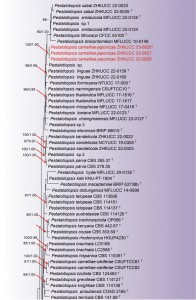
Maximum likelihood tree inferred from the combined ITS, tef1-α and tub2 sequence data for Pestalotiopsis camelliae-japonicae, P. pyrrosiae-linguae, and P. zhaoqingensis. Maximum likelihood bootstrap support values equal to or greater than 80% and Bayesian posterior probabilities equal to or greater than 0.95 are given above the nodes (ML/BYPP). The tree is rooted to Neopestalotiopsis magna (MFLUCC 12-0652). Ex-type strains are indicated with “T”. The new species from South China region are indicated in red.
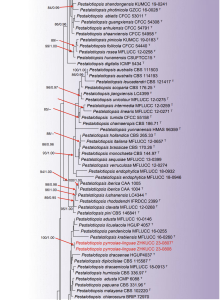
Continued.

Continued.