

Montagnula chromolaenicola Mapook & K.D. Hyde
Classification – Didymosphaeriaceae, Pleosporales, Dothideomycetes, Ascomycota
Index Fungorum number – IF557298; Facesoffungi number – FoF 07791
Other useful webpages – outlineoffungi.org; fungalgenera.org; Dothideomycetes.org
Description – Saprobic on dead stems of Citrus maxima. Sexual morph: Ascomata 230–340 μm high × 180–300 μm diam. (av. 300 × 250 μm, n = 10), semi-immersed, conspicuous protruding through host surface, solitary, scattered, elliptical or subglobose, most uniloculate, few multiloculate, brown to black, smooth-walled, papillate, with a central ostiole. Ostiole 60–240 μm diam. (av. 100 μm, n = 20), central, closed, filled with periphyses or empty, consisting of light brown to brown stromatal tissue cells. Peridium 20–50 μm wide, thin-walled, containing 5–7-layers of transparent to dark brown cells of textura angularis from inner to outside, outermost layer fuses with host tissues. Hamathecium 1.5–3 μm wide (av. 2.5 μm, n = 50), dense, cylindrical, filamentous, branched, with indistinct septate, gelatinous matrix wraps the trabeculate pseudoparaphyses and clearly match between asci. Asci 30–50 × 3–5 μm (av. 40×5 μm, n = 15), 8-spored, bitunicate, thin-walled, clavate, blunt apically, with long slightly curved furcated pedicel. Ascospores 5–10×3–5 μm (av. 6 × 4 μm, n = 30), biseriate, ellipsoidal, 1-septate, significant contraction at the septa, tapering from the center to the ends, cells at the upper are slightly wider than lower cells, hyaline when immature, dark brown to brown at maturity, without appendages and mucilaginous sheath. Asexual morph: undetermined.
Culture characteristics – Ascospore germinating on PDA within 24 h at room temperature. Colonies on PDA reaching 50 mm diam. after 1 week at 25 °C, circular, fat, smooth, dense and soft, surface view white to light gray from center to edge; reverse with olive-green to light brown center, white edge.
Material examined – China, Guangdong Province, Shaoguan City, Renhua County, Dongtang town, 25°3′50″ N, 113°39′17″ E, on the bark of Citrus maxima (Rutaceae), 25 August 2021, Y.H. Yang (MHZU 22-0065, new host record); living cultures ZHKUCC 22-0118, ZHKUCC 22-0119, ZHKUCC 22-0120.
GenBank accession numbers – ITS: OQ976005, OQ976006, OQ976007; LSU: OQ976015, OQ976016, OQ976017; SSU: OQ976021, OQ976022; tef1-α: OQ980478.
Notes – See Senanayake et al. (2023).
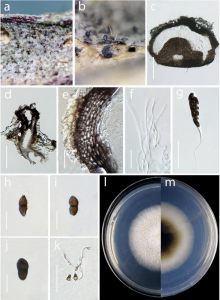
Montagnula chromolaenicola (MHZU 22-0065, new host record). a, b Ascomata on the host surface. c Vertical cross section of ascoma. d Cross section through the ostiole. e Peridium. f Pseudoparaphyses. g Asci. h–j Ascospores. k Germinating ascospore. l Surface view of colony on PDA. m Reverse view of colony on PDA. Scale bars: c, d = 100 µm, e, f, h–j = 20 µm, g, k = 30 µm.
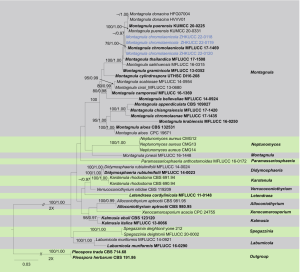
Phylogram generated from maximum likelihood analysis based on combined ITS, LSU, SSU and tef1-α sequence data for Montagnula chromolaenicola. Bootstrap support values for maximum likelihood equal to or greater than 75% and Bayesian posterior probabilities from Bayesian inference analysis equal to or greater than 0.95 are given at each node (ML/BYPP). The tree is rooted to Pleospora herbarum (CBS 191.86) and P. trada (CBS 714.68). Ex-type strains are in bold. The new isolates from South China region are indicated in blue.