

Letendraea cordylinicola Phook., Ariyaw. & K.D. Hyde
Classification – Didymosphaeriaceae, Pleosporales, Dothideomycetes, Ascomycota
Index Fungorum number –IF550695; Facesoffungi number – FoF 00047
Other useful webpages – outlineoffungi.org; fungalgenera.org; Dothideomycetes.org
Description – Associated with Synsepalum dulcificum leaf spots. Sexual morph: Asci 8-spored, brown, bitunicate, fissitunicate, cylindric-clavate, short pedicellate, apically rounded with an indistinct ocular chamber, arising from the base of the ascoma. Ascospores 10–15 µm × 3–5 µm (av. 14 ± 0.9 × 4 ± 0.4 µm, n = 50), 1–3 seriate, didymosporous, fusiform, pale brown to brown, 1-septate, constricted at the septum, often enlarged near septum in the upper cell, smooth-walled, with distinct appendage at both ends, surrounded by a mucilaginous sheath. Asexual morph: undetermined.
Culture characteristics – Colonies on PDA reaching 5 cm diam. after 7 days at 25 °C, white, becoming light yellow from above, white to orange-red from the center and some white dot on it; orange-red from below, margin with well-defined to slightly radiating. Colonies on MEA and OA reaching 5 cm after 7 days at 25 °C.
Material examined – China, Guangzhou, Guangdong Province, on Synsepalum dulcificum (Schumach. & Thonn.) Daniell., (Sapotaceae), March 2021, Y.H. Huang & L.Q. You, living culture ZHKUCC 21-0108, new host record.
GenBank accession numbers – LSU: OL687397; ITS: OL687396.
Notes – See Manawasinghe et al. (2022).
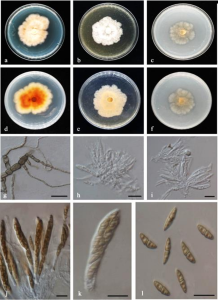
Letendraea cordylinicola (ZHKUCC 21-0108, new host record). a, d Colony characters on PDA (a upper view; d reverse view). b, e Colony characters on MEA (b upper view; e reverse view). c, f Colony characters on OA (c upper view; f reverse view); g Mycelium. h–k Asci. l Ascospores. Scale bars: h–i = 25 µm, j–l = 10 µm.
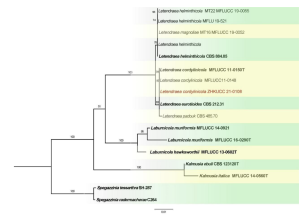
Maximum likelihood tree inferred from the combined LSU, SSU and ITS sequence data for Letendraea cordylinicola. The tree is rooted to Spegazzinia tessathra (SH-287) and S. rademacherae (C264). Maximum likelihood bootstrap support values (ML) equal to or greater than 50% are given above the nodes. Ex-type strains are indicated with “T”. The new isolate from South China region is indicated in red.