

Jahnula oblonga Senan. & K.D. Hyde
Classification – Aliquandostipitaceae, Jahnulales, Dothideomycetes, Ascomycota
Index Fungorum number – IF900237; Facesoffungi number – FoF 14166
Other useful webpages – outlineoffungi.org; fungalgenera.org; Dothideomycetes.org
Etymology – based on the oblong-shaped ascospores
Holotype – MHZU 22-0128
Description – Saprobic on submerged decaying wood. Sexual morph: Ascomata 350–380×310–345 μm (av. 360×325 μm, n = 5), erumpent to superficial with the immersed base, solitary, scattered, globose to subglobose, dark brown to black, coriaceous, papillate, ostiolate. Papilla central, short, lined with hyaline periphyses. Peridium 35–75 μm thick, comprising outer, 4–6 layers of large, brown, thick-walled cells of textura angularis and inner, 3–5 layers of compressed, hyaline, thick-walled cells of textura angularis. Hamathecium comprising 2–3 μm wide, septate, branched, filiform pseudoparaphyses, embedded in a gelatinous matrix. Asci 110–150×30–35 μm (av. 125×32 μm, n = 20), 8-spored, bitunicate, fissitunicate, oblong fusiform, short or apedicellate, apex rounded, with an indistinct ocular chamber. Ascospores 30–33 × 15–18 μm (av. 32 × 16 μm, n = 50), biseriate, oblong, 1-septate, slightly constricted at the septum, rough-walled, multi-guttulate, greenish-brown, apiculate. Asexual morph: undetermined.
Culture characteristics – Colonies on PDA reaching 2 cm diam. after 10 days in dark at 25 °C, fat, circular, with inner, concentric zonation around the centre with dark brown to greyish brown, woolly aerial mycelia with curled margin, then filamentous hyphae extend out to form paler, thin outer zone with filiform margin, reverse blackish brown, no pigments produced.
Material examined – China, Guangdong Province, Guangzhou City, Baiyun Mountain, on submerged decaying wood, 16 August 2021, Jinzhen Fu, WBHS 12 (MHZU 22-0128, holotype), ex-type culture ZHKUCC 22-0223; ibid. ZHKUCC 22-0235 .
GenBank accession numbers – ITS: OR164944, OR164945, LSU: OR164972, OR164973.
Notes – See Senanayake et al. (2023).
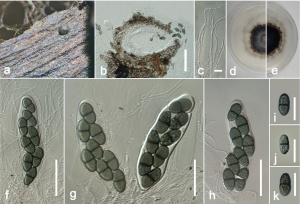
Jahnula oblonga (MHZU 22-0128, holotype). a Ascomata on submerged wood. b Vertical section of ascoma. c Pseudoparaphyses. d Surface view of colony on PDA. e Reverse view of colony on PDA. f–h Asci. i–k Ascospores. Scale bars: b = 200 µm, c = 10 µm, f–h = 60 µm, i–k = 30 µm.
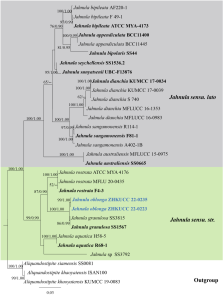
Phylogram generated from maximum likelihood analysis based on combined ITS, LSU and SSU sequence data for Jahnula oblonga. Bootstrap support values for maximum likelihood equal to or greater than 50% and Bayesian posterior probabilities from Bayesian inference analysis equal to or greater than 0.90 are given at each node (ML/BYPP). The tree is rooted to Aliquandostipite khaoyaiensis (ISAN100), A. khaoyaiensis (KUMCC 19-0083) and A. siamensis (SS0081). Ex-type strains are in bold. The new isolates from South China region are indicated in blue.