

Coniochaeta velutina (Fuckel) Cooke
Basionym – Rosellinia velutina Fuckel
Classification – Coniochaetaceae, Coniochaetales, Diaporthomycetidae, Sordariomycetes, Ascomycota
Index Fungorum number – IF295496; Facesoffungi number – FoF 10626
Other useful webpages – outlineoffungi.org; fungalgenera.org; Sordariomycetes.org;
Description – Endophytic on healthy Phyllostachys viridis leaves. Sexual morph: undetermined. Asexual morph: Hyphomycetous. Conidiogenous cells 1–2 × 1–3 μm (av. 1.5 × 2.5 μm, n = 11), hyaline, flask-shaped or acicular. Conidia 3–5 × 2–4 μm (av. 3.8 × 2.8 μm, n = 50), hyaline, smooth-walled, ellipsoidal. Chlamydospores 3–5 × 4–5 μm (av. 3.5 × 4 μm, n = 2), solitary or in short chains, hyaline, thick-walled, elongate ellipsoidal or almost globose.
Culture characteristics – Conidia germinating on PDA within 12 hours at 25 °C, reaching 4 cm diam. after 14 days at 28 °C, circular, for above, dividing into two layers, gray and white at the top layer, and gray at the bottom layer. Reverse, centre dark yellow, toward the edges, gradually becoming lighter, white margin, circular, flat, scattered, partially immersed in the medium; centre of the colony slightly raised.
Material examined – China, Guangdong Province, Guangzhou City, South China Botanical Garden, from healthy leaves of Phyllostachys viridis (R. A. Young) McClure (Poaceae), 17 June 2020, HJ. Zhao & M. Luo, living cultures, ZHKUCC 21-0112 and ZHKUCC 21-0113, new host record).
GenBank accession numbers – ITS: OL763837, OL764359; LSU: OL763831, OL763899.
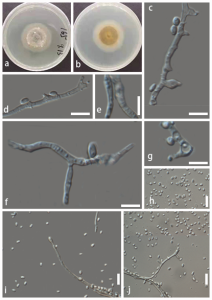
Coniochaeta velutina (ZHKUCC 21-0112, new host record). a, b Cultures on PDA from the surface and reverse. c, d Conidiogenous cells. e, f Conidiogenous cells producing conidia. g Chlamydospores. h–j Conidia. Scale bars: c–j = 10 μm.
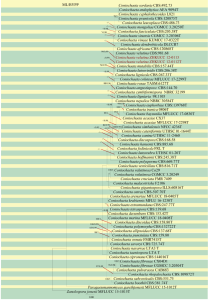
Maximum likelihood tree inferred from the combined SSU, ITS, LSU, tef1-α, rpb2 and tub2 sequence data for Coniochaeta velutina. The tree is rooted to Zanclospora jonesii (MFLUCC 15-1015) and Paragaeumannomyces garethjonesii (MFLUCC 15-1012). RAxML bootstrap support values equal to or greater than 75% and Bayesian posterior probabilities equal to or greater than 0.95 are shown near the nodes (ML/BYPP). Ex-type strains are indicated with T. The new isolated from South China region are indicated in red.