

Colletotrichum truncatum (Schwein.) Andrus & W.D. Moore
Basionym – Vermicularia truncata Schwein.
Classification – Glomerellaceae, Glomerellales, Hypocreomycetidae, Sordariomycetes, Ascomycota
Index Fungorum number – IF280780; Facesoffungi number – FoF 03827
Other useful webpages – outlineoffungi.org; fungalgenera.org; Sordariomycetes.org; coelomycetes.org
Description – Saprobic on diseased leaves of Catharanthus roseus. Asexual morph: Vegetative hyphae hyaline, septate, branched, 1–8 µm diam. Conidiomata black, scattered or in groups. Setae (62–)76–99(–141) × 5–8 µm (av. 93 × 7 µm, n = 30), 3–4-septate, medium to dark brown, base cylindrical, tip broadly truncate. Conidiophores hyaline to pale brown, septate, branched, densely clustered, up to 90 µm long. Conidiogenous cells 6–20 × 2.5–4 µm (av. 13 × 3.5 µm, n = 30), hyaline to pale brown, cylindrical. Conidia (20–)26 × 31(–34) × 4–5 µm (av. 28 × 5 µm, n = 50), hyaline, smooth-walled to verruculose, aseptate, curved, ending abruptly at the round and truncate base, while tapering towards the acute and more strongly curved apex, contents granular. Appressoria 11–14(–17) × 7–11 µm (av. 13 × 9, n = 30), solitary, in groups or dense clusters, pale to medium brown, entire edge to lobed, outline roundish to ellipsoidal or clavate, contact point of hyphae often above the appressorium.
Culture characteristics – Colonies on PDA reaching 60 mm diam. after 7 days, flat with entire margin, aerial mycelium lush, cottony, yellow-white, hyaline towards margin, with concentric zonation, reverse dark vinaceous buff. Colonies on SNA reaching 55 mm diam. after 7 days, white, conidial masses pale yellow.
Material examined – China, Guangdong Province, Meizhou City, on leaf spot of Catharanthus roseus (L.) G. Don (Apocynaceae), October 2021, Jingwen Chen (MHZU 23-0209 dried culture), living cultures ZHKUCC 23-0870; ZHKUCC 23-0871 and ZHKUCC 23-0872.
GenBank accession numbers – gapdh: OR493929; act: OR493895; chs-1: OR493912; ITS: OR285936; tub2: OR453381. For additional GenBank accession numbers, please refer to Zhang et al. (2023) on page 302.
Notes – See Zhang et al. (2023).
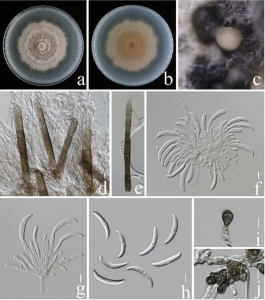
Colletotrichum truncatum (ZHKUCC 23-0870, new host record). a, b Upper and reverse view on PDA (7 d). c Conidial masses on SNA. d, e Setae. f, g Conidiogenous cells. h Conidia. i, j Appressoria. Scale bars: d–j = 10 µm.
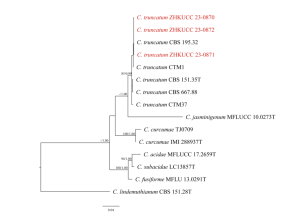
Maximum likelihood tree inferred from the combined ITS, gapdh, chs-1, act, and tub2 sequence data for Colletotrichum truncatum. The tree is rooted to C. lindemuthianum (CBS 151.28). Maximum likelihood bootstrap support values equal to or greater than 75% and Bayesian posterior probabilities equal to or greater than 0.95 are given at the nodes and branches (ML/BYPP). Ex-type isolates are marked with “T”. The new isolates from South China region are indicated in red.