

Colletotrichum plurivorum Damm, Alizadeh & Toy. Sato
Classification – Glomerellaceae, Glomerellales, Hypocreomycetidae, Sordariomycetes, Ascomycota
Index Fungorum number – IF824228; Facesoffungi number – FoF 10691
Other useful webpages – outlineoffungi.org; fungalgenera.org; Sordariomycetes.org; coelomycetes.org
Description – Associated with leaf spot of Cymbidium sinense. Sexual morph: Ascomata 120–200(–280) × (80–)110–160(–210) μm (av. 180 × 140 μm, n = 30), formed after 3 weeks on SNA, solitary, superficial or immersed, black, subglobose to pyriform. Asci 45–65(–70) × 9–13 μm (av. 54 × 11 μm, n = 50), cylindrical or clavate, broadly truncate at base, 8-spored. Ascospores 18–24 × 5–7 μm (av. 21 × 6 μm, n = 50), biseriately arranged, aseptate, hyaline, fusiform, with rounded ends. Asexual morph: undetermined.
Culture characteristics – Colonies on PDA reaching 90 mm diam. after 7 days, white, flat at the entire margin, aerial mycelium lush, cottony, reverse dark green to brown, ascomata black.
Material examined – China, Guangdong Province, Zhongshan City, on leaf spot of Cymbidium sinense (Jack. Ex Andr.) Willd. (Orchidaceae), August 2021, Yunxia Zhang and Jingwen Chen (living cultures ZHKUCC 23-0861 and ZHKUCC 23-0862, new host record).
Additional materials – China, Guangdong Province, Zhongshan City, on leaf spot of Paphiopedilum sp. (Orchidaceae), August 2021, Yunxia Zhang and Jingwen Chen (living culture ZHKUCC 23-0863 and ZHKUCC 23-0864, new host record); China, Guangdong Province, Meizhou City, on leaf spot of Cymbidium sinense (Orchidaceae), October 2021, Jingwen Chen (living culture ZHKUCC 23-0865 and ZHKUCC 23-0866); China, Guangdong Province, Zhongshan City, on the stem of Impatiens balsamina Linn. (Balsaminaceae) October 2021, Jingwen Chen (living culture ZHKUCC 23-0867, ZHKUCC 23-0868 and ZHKUCC 23-0869, new host record).
GenBank accession numbers – gapdh: OR493872, OR493873; act: OR493816, OR493817; chs-1: OR493844, OR493845; ITS: OR286370, OR286371; tub2: OR453358, OR453359. For additional GenBank accession numbers, please refer to Zhang et al. (2023) on page 300.
Notes – See Zhang et al. (2023).
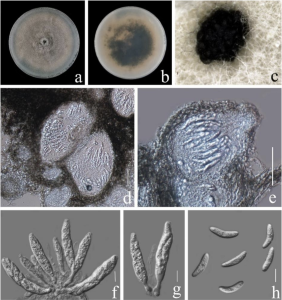
Colletotrichum plurivorum (ZHKUCC 23-0861, new host record). a, b Upper and reverse view on PDA (7 d). c Ascomata on SNA. d, e Ascomata in longitudinal section. f, g Asci. h Ascospores. Scale bars: d = 20 μm, e–h = 10 µm.
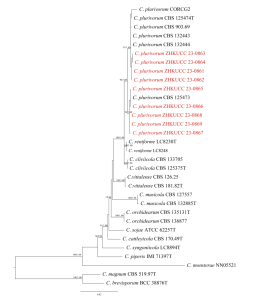
Maximum likelihood tree inferred from the combined ITS, gapdh, chs-1, act, and tub2 sequence data for Colletotrichum plurivorum. The tree is rooted to C. brevisporum (BCC 38876) and C. magnum (CBS 519.97). Maximum likelihood bootstrap support values equal to or greater than 75% and Bayesian posterior probabilities equal to or greater than 0.95 are given at the nodes and branches (ML/BYPP). Ex-type isolates are marked with “T”. The new isolates from South China region are indicated in red.