

Colletotrichum pandanicola Tibpromma & K.D. Hyde
Classification – Glomerellaceae, Glomerellales, Hypocreomycetidae, Sordariomycetes, Ascomycota
Index Fungorum number – IF823841; Facesoffungi number – FoF 10612
Other useful webpages – outlineoffungi.org; fungalgenera.org; Sordariomycetes.org; coelomycetes.org
Description – Associated with leaf spot of Reineckia carnea. Sexual morph: undetermined. Asexual morph: ceolomycetous. Conidia 14–17 × 4–6 μm (av. 15 × 5 μm, n = 50), formed with mycelium, one-celled, smooth-walled, most slightly rounded at the ends, slightly curved at one end, some rounded at both ends. Appressoria in slide cultures 10–16 × 4–7 (–8) μm (av. 12 × 6 μm, n = 50), formed from branched mycelia, brown, some oval to nearly rhombic and often becoming complex with age.
Culture characteristics – Colonies on PDA attaining 70 mm in diam., in 7 days at 25 ℃, at first white, becoming light brown, in reverse pale yellowish. Aerial mycelium greyish-white, dense, cottony, without setae and sclerotium produced.
Material examined – China, Guangdong Province, Shenzhen Botanical Garden, associated with leaf spot on Reineckia carnea (Andr.) Kunth., (Convallariaceae), 30 November 2020, J.W. Chen, Z.L. Mai, C. Chen, living cultures ZHKUCC 21-0079 and ZHKUCC 21-0080, new host record.
GenBank accession numbers – gapdh: OL672737, OL672738; act: OL672717, OL672718; chs-1: OL672727, OL672728; tub2: OL739542, OL739543.
Notes – See Manawasinghe et al. (2022).
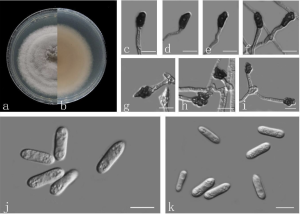
Colletotrichum pandanicola (ZHKUCC 21-0079, new host record). a, b Upper and reverse view on PDA after seven days. c-i Appressoria. j, k Conidia. Scale bars: c–k = 10 µm.
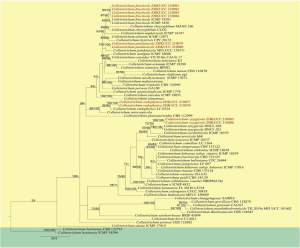
Maximum likelihood tree inferred from the combined ITS, gapdh, act, chs-1 and tub2 sequence data for Colletotrichum endophyticum, C. fructicola, C. pandanicola, and C. syzygicola. The tree is rooted to C. boninense (CBS123755 and ICMP 18596). Maximum parsimony and maximum likelihood bootstrap support values equal to or greater than 50% are given at the nodes and branches (MP/ML). The new isolates from South China region are indicated in red.