

Colletotrichum chamaedoreae F. Liu, W.P. Wu & L. Cai
Classification – Glomerellaceae, Glomerellales, Hypocreomycetidae, Sordariomycetes, Ascomycota
Index Fungorum number – IF841374; Facesoffungi number – FoF 15257
Other useful webpages – outlineoffungi.org; fungalgenera.org; Sordariomycetes.org; coelomycetes.org
Description – Associated with leaf spot of Chrysalidocarpus lutescens. Sexual morph: Ascomata 130–180 (–220) × 100–150 (–180) μm (av. 160 × 130 μm, n = 30), formed after 4 weeks, black, globose to subglobose, semi-immersed or immersed. Asci 50–70(–84) × 11–16(–18) μm (av. 63 × 14 μm, n = 30), 6–8 spores, hyaline, clavate or cymbiform, apex and base acute. Ascospores 18–23(–25) × 5–8 μm (av. 21 × 7 μm, n = 50), uni-or biseriately arranged, aseptate, hyaline, fusiform, slightly curved. Asexual morph: Vegetative hyphae hyaline, smooth-walled, septate, branched. Setae 46–71 μm long, 1–7 septate, dark brown, base cylindrical, tip broadly acute. Conidiomata black, scattered or in groups. Conidiogenous cells 9–16(–20) × 4–7 μm (av. 12 × 5 μm, n = 50), hyaline or pale brown, smooth, cylindrical. Conidia 17–21 × 6–9 μm (av. 19 × 8 μm, n = 50), aseptate, smooth-walled, hyaline, mostly both ends round, sometimes one end with a prominent truncate scar. Appressoria 9–13(–15) × (6–)8–12(–15) μm (av. 11 × 10 μm, n = 50), dark brown, irregular.
Culture characteristics – Colonies on PDA reaching 60 mm diam. after 7 days at 25 ℃, green-grey, white edges, flat, regular, mycelium flocculent, reverse orange, conidial masses orange.
Material examined – China, Guangdong Province, Guangzhou City, on leaf spot of Chrysalidocarpus lutescens H. Wendl (Arecaceae), October 2021, Yunxia Zhang and Jingwen Chen (living culture ZHKUCC 23-0855, new host record); ibid. ZHKUCC 23-0856.
GenBank accession numbers – gapdh: OR493866, OR493867; act: OR493810, OR493811; chs-1: OR493838, OR493839; ITS: OR272087, OR272088; tub2: OR426927, OR453353.
Notes – See Zhang et al. (2023).
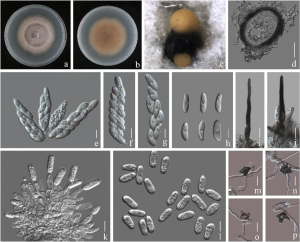
Colletotrichum chamaedoreae (ZHKUCC 23-0855, new host record). a, b Upper and reverse view on PDA (7 d). c Conidial masses. d Ascomata. e–g Asci. h Ascospores. i, j Setae. k Conidiogenous cells. l Conidia. m–p Appressoria. Scale bars: d = 20 μm, e–p = 10 µm.
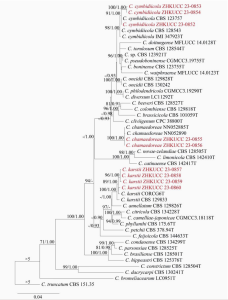
Maximum likelihood tree inferred from the combined ITS, gapdh, chs-1, act, and tub2 sequence data for Colletotrichum chamaedoreae, C. cymbidiicola, and C. karsti. The tree is rooted to C. truncatum (CBS 151.35). Maximum likelihood bootstrap support values equal to or greater than 70% and Bayesian posterior probabilities equal to or greater than 0.90 are given at the nodes and branches (ML/BYPP). Ex-type isolates are marked with “T”. The new isolates from South China region are indicated in red.