

Melomastia pyriformis Kular. & Senan.
Classification – Pleurotremataceae, Dyfrolomycetales, Dothideomycetes, Ascomycota
Index Fungorum number – IF558382; Facesoffungi number – FoF 13244
Other useful webpages – outlineoffungi.org; fungalgenera.org; Dothideomycetes.org
Etymology – Species epithet derived from the pyriform ascomata
Holotype – MHZU 22-0092
Description – Saprobic on twigs of an unidentified plant. Sexual morph: Ascomata 330–640 × 275–420 µm (av. 510 × 342 µm, n = 10), solitary or gregarious, erumpent to superficial when mature, pyriform, dark brown to black, coriaceous, papillate, ostiolate. Clypeus 10–40 µm thick, extending outwards around the ascomata, thicker around the papilla, composed of dense, melanized cells. Papilla 105– 110 × 105–115 µm (av. 108 × 109 µm, n = 10), central, wide, ostiolar canal internally covered by filiform periphyses. Peridium 20–50 µm (av. 22 µm, n = 10), thin at the base and become thick towards sides, comprised of brown, thick-walled, cells of textura intricata in sides; and thin-walled, pale brown, cells of textura angularis in base. Hamathecium comprising numerous, dense, filiform, unbranched, septate, 1.8–2.5 µm wide pseudoparaphyses, anastomosing between and above the asci. Asci 135–160 × 5.5–7.5 µm (av. 138 × 6.3 µm, n = 10), 8-spored, bitunicate, fissitunicate, cylindrical, apically round, with an indistinct ocular chamber, short pedicellate, straight or slightly curved. Ascospores 20–25 × 4.5–7 µm (av. 21 × 5.3 µm, n = 10), uniseriate to overlapping uniseriate, fusiform with acute ends, hyaline, 3-septate, not constricted at the septa, with guttules in each cell, smooth-walled without a sheath or appendages. Asexual morph: undetermined.
Culture characteristics – Colonies on PDA reaching 2 cm after 2 weeks incubating at 25 °C in dark, irregular, umbonate, filiform margin, slightly raised in the center, off-white, covered with wooly areal mycelial clots, reverse yellowish brown. No sporulation and pigmentation observed in agar medium within 30 days.
Material examined – China, Guangdong Province, Guangzhou City, Zhongkai University of Agriculture and Engineering (23°06’28.4″N 113°16’51.6″E), on dead twigs of an unidentified plant, 5 June 2022, N.D. Kularathnage, NDK 58 (MHZU 22-0092, holotype); ex-type culture ZHKUCC 22-0175.
GenBank accession numbers – LSU: OP791870, SSU: OP739334, tef1-α: OQ718392.
Notes – See Kularathnage et al. (2023)
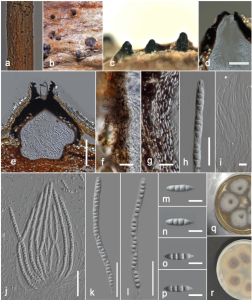
Melomastia pyriformis (MHZU 22-0092, holotype). a Dead twig of an unidentified plant. b, c Appearance of ascomata on the substrate. d Vertical section through ostiole cannel. e Vertical section of an ascoma. f, g Peridium (f at base, g at sides). h Apical chamber of an ascus. i Pseudoparaphyses. j–l Asci. m–p Ascospores. q Front view of colony on PDA. r Reverse view of colony on PDA. Scale bars: d, e = 200 μm, f, g = 20 μm, i = 5 μm, h, j–l = 40 μm, m–p = 10 μm.
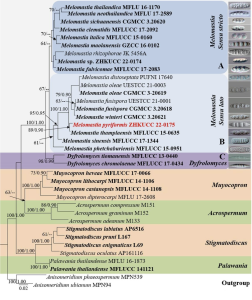
Maximum likelihood consensus tree inferred from the combined LSU, SSU and tef1-α multiple sequence alignments for Melomastia pyriformis. Bootstrap support values for maximum likelihood (ML, first value) equal to or greater than 60% and Bayesian posterior probabilities from MCMC analyses (BYPP, second value) equal to or greater than 0.90 are given above the nodes. The scale bar indicates expected changes per site. The tree is rooted to Anisomeridium phaeospermum MPN539 and A. ubianum MPN94. Ex-type cultures are presented in bold. The new species is indicated in red.