

Melomastia loropetalicola Kular., W. Dong & K.D. Hyde
Classification – Pleurotremataceae, Dyfrolomycetales, Dothideomycetes, Ascomycota
Index Fungorum number – IF900860; Facesoffungi number – FoF 14684
Other useful webpages – outlineoffungi.org; fungalgenera.org; Dothideomycetes.org
Etymology – referring to the host genus Loropetalum, from where the fungus was isolated.
Holotype – MHZU 22-0091
Description – Saprobic on dead stem of Loropetalum chinense. Sexual morph: Ascomata 400–450 μm high, 300–320 μm diam., scattered, immersed or semi-immersed with erumpent papilla forming a black, cone-shaped structure on the host substrate, subglobose, unilocular, ostiolate, papillate, black, carbonaceous. Peridium 25–35 μm thick, comprising of dark brown to black, thick-walled, compressed cells of textura angularis and irregular cells, outer layer composed of amorphous cells fused with host substrate. Pseudoparaphyses 1–2 μm diam., numerous, cellular, cylindrical, aseptate, unbranched, hyaline. Asci 100–120 × 3–4.5 μm (av. 110 × 3.5 μm, n = 20), 8-spored, bitunicate, cylindrical, thin-walled, apically rounded, short pedicellate, with a bilobed, apical ring and an ocular chamber. Ascospores 13–16 × 3–4 μm (av. 15 × 3.5 μm, n = 20), uniseriate, straight or slightly curved at ends, fusiform with acute or obtuse ends, 3-septate, with one large guttulate in each cell, hyaline, thin-walled, without a sheath. Asexual morph: undetermined.
Material examined – China, Guangdong Province, Shenzhen City, Shenzhen University, on dead stem of Loropetalum chinense (R.Br.) Oliv. (Hamamelidaceae), 5 August 2020, N.D. Kularathnage, NDK 32 (MHZU 22-0091, holotype); ex-type culture ZHKUCC 22-0174.
GenBank accession numbers – LSU: OP791870, SSU: OP739334.
Notes – See Dong et al. (2023)
Known host – Loropetalum chinense (Dong et al. 2023)
Known distribution – China (Dong et al. 2023)
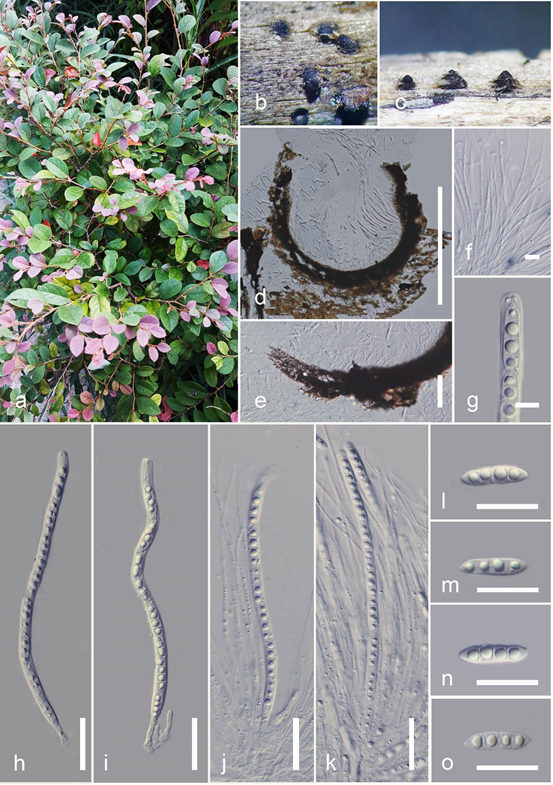
Melomastia loropetalicola (MHZU 22-0091, holotype). a Host. b, c Appearance of black ascomata erumpent on host. d Vertical section of an ascoma. e Peridium. f Pseudoparaphyses. g Apical apparatus. h–k Asci. l–o Ascospores. Scale bars: d = 300 μm, e = 40 μm, f, g = 5 μm, h–k = 20 μm, l–o = 15 μm.
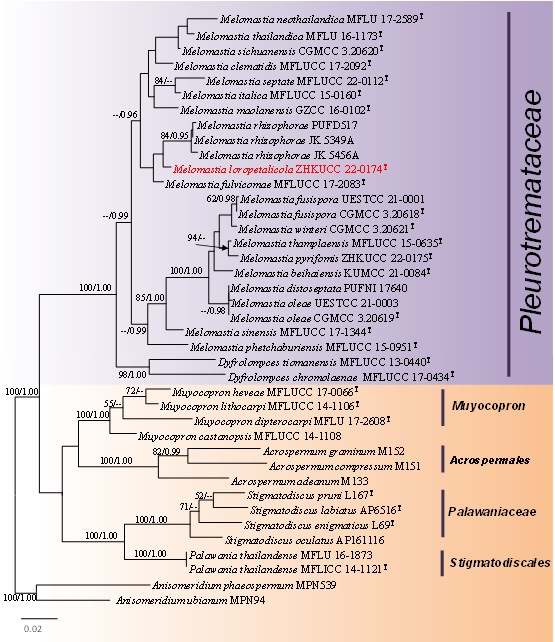
Maximum likelihood tree inferred from the combined LSU, SSU and tef1-α multiple sequence alignments for Melomastia loropetalicola. Bootstrap support values for maximum likelihood (ML, first value) equal to or greater than 50% and Bayesian posterior probabilities from MCMC analyses (BYPP, second value) equal to or greater than 0.90 are given above the nodes. The scale bar indicates expected changes per site. The tree is rooted to Anisomeridium phaeospermum MPN539 and A. ubianum MPN94. Ex-type strains are indicated with “T”. The new species is indicated in red.